Have you ever wondered why the name Hannah feels so full of meaning? In the Bible, Hannah is far more than just a name it is a story of a woman who refused to give up when life gave her every reason to.
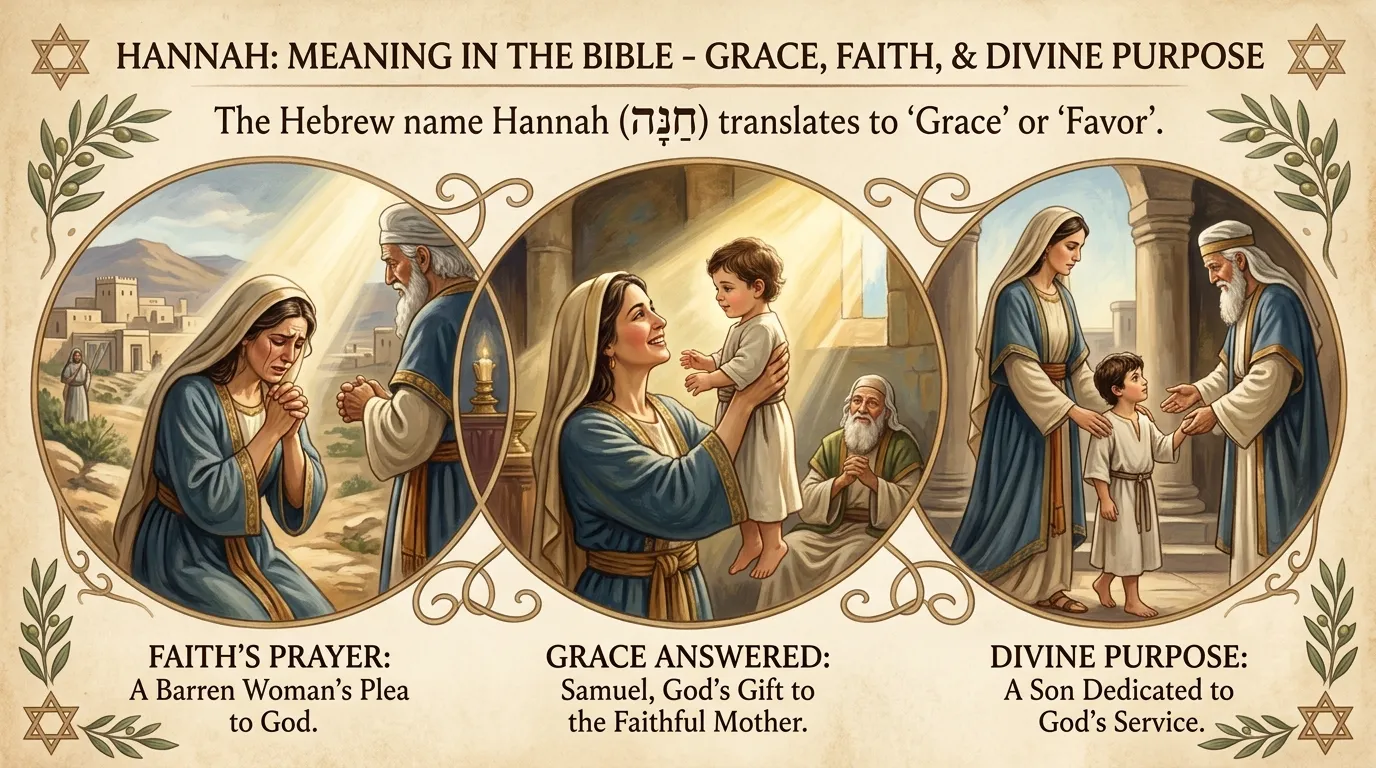
Hannah meaning in Bible comes from the Hebrew word Channah (חַנָּה), which translates to “grace,” “favor,” and “compassion.” And this meaning is perfectly woven into every chapter of her life.
Found in 1 Samuel, Hannah was a woman crushed by barrenness, mocked by her rival, and misunderstood by even the priest. Yet she poured her heart out to God in raw, honest prayer — and God heard her.
Her story is not just ancient history. It is a timeless reminder that grace finds you in your deepest pain, and divine purpose is always worth the wait.
What Does Hannah Mean in the Bible?
The name Hannah comes from the Hebrew word חַנָּה (Channah), rooted in “chen” — meaning grace, favor, mercy, and compassion.
Translated simply: Hannah means “grace” or “God has favored me.”
But here is what makes this name truly remarkable — Hannah’s life perfectly matches her name. She did not receive grace because her life was easy. She received grace because her life was impossibly hard, and she chose to trust God through every painful moment of it.
“Her name means grace — and grace is exactly what she lived for.”
Who Was Hannah in the Bible?
Hannah’s story is found in 1 Samuel 1–2, and it opens with heartbreak.
Elkanah, her husband, had two wives — Hannah and Peninnah. Peninnah had many children. Hannah had none. In ancient Israelite culture, a woman’s identity and social worth were deeply tied to her ability to have children. Barrenness was not just a personal sorrow — it was a source of public shame.
And Peninnah knew this. She taunted Hannah regularly, twisting the knife of her pain with cruel words and comparisons (1 Sam. 1:6). The Hebrew word for “rival” used to describe Peninnah literally means “rival-wife” — a woman who competed by wounding.
Hannah was:
- Publicly humiliated daily
- Struggling under enormous social pressure
- Battling deep depression and grief
- So brokenhearted she could not eat or stop weeping (1 Sam. 1:7)
Put yourself in her place for a moment. What do you long for so deeply that it steals your appetite? A child? A relationship? A breakthrough that will not come? A healing that is delayed? You are in good company with Hannah.
Hannah Brought Her Struggles to God
What did Hannah do with her broken heart? She did not suppress it. She did not pretend. She did not give up.
She went to the Lord’s house and prayed.
And not a polished, tidy, “sound spiritual” kind of prayer. She wept so bitterly, so openly, so desperately — that Eli the priest thought she was drunk (1 Sam. 1:13).
Here is what makes Hannah extraordinary among all the women of the Old Testament:
- She is the only Old Testament woman recorded to go to the Lord’s house on her own
- She is the only Old Testament woman to make a vow to the Lord
- She spoke God’s personal name Yahweh more than any other woman in the Old Testament
- She called herself “God’s servant” three times — a posture of deep humility
- She knew God more intimately than Eli, the priest himself
That last point deserves a pause.
While Eli used the formal title “God of Israel,” Hannah used God’s personal name — Yahweh. While Eli sat at the doorway of the tabernacle, Hannah walked right inside and poured her whole heart out. While Eli could not clearly hear God’s voice (1 Sam. 3), Hannah saw directly to the heart of her situation and humbly asked for help.
Hannah was not a priest. She had no title. She was a brokenhearted, barren woman — and she knew God more deeply than her spiritual leader did.
You do not need a title, a platform, or a polished testimony to draw close to God. You just need to go to Him.
Hannah Prayed With Radical Honesty
Hannah’s prayer in 1 Samuel 1:11 is one of the most raw and real prayers in all of Scripture:
“O LORD of hosts, if you will indeed look on the affliction of your servant and remember me and not forget your servant, but will give your servant a son, then I will give him to the LORD all the days of his life.”
She did not pray a shallow, safe prayer. She laid out her exact pain. She begged. She wept. She made a bold, costly promise.
Most of us are tempted to pray safe prayers — “Lord, give me peace” when we are drowning in anxiety. But Hannah teaches us something better: God wants our hearts as they actually are, not as we wish they would be.
In fact, one in every three Psalms is a psalm of lament — weeping, complaining, and begging God for help. Honest brokenness is not a lack of faith. It is faith.
“In her deep anguish Hannah prayed to the Lord, weeping bitterly.” — 1 Samuel 1:10
If Hannah can cry honestly to God, so can you. The God of Hannah is also the God of you.
God Heard Hannah — and Answered
After Hannah poured out her soul, Eli gave her a blessing: “Go in peace, and the God of Israel grant your petition” (1 Sam. 1:17). She wiped her tears and left — and the Bible says she was no longer sad.
She had not yet received the answer. But she had released the burden.
Soon after, Hannah conceived and gave birth to a son.
She named him Samuel — which sounds like the Hebrew for “heard of God.” Every single time someone called her son’s name, Hannah was reminded: God heard me. God answered me. God did not forget me.
That phrase — “the Lord remembered her” — is one of the most tender lines in all of the Bible. Not that God had forgotten. But that in His perfect timing, He moved on her behalf.
Hannah Surrendered What She Loved Most
Here is where the story becomes almost unbelievable.
Hannah had promised God: if You give me a son, I will give him back to You. And she meant it.
When Samuel was still a small child, barely weaned — Hannah walked him to the temple and gave him to Eli to serve God for the rest of his life. Her only son. The child she had prayed, wept, and ached for.
How could she do it?
Because by the time God gave her Samuel, Hannah had already surrendered herself to God. She had already placed her deepest longing into His hands. She had already trusted Him with her most painful wound. Trusting Him with her greatest blessing was simply the next step in the same journey of faith.
Every year after that, she brought Samuel a new robe she had sewn herself. Imagine her — stitching each one a little larger than the last, measuring the growth of the boy she had given back to God, rejoicing in the faithfulness of the One who had given him to her in the first place.
Hannah Rejoiced in God’s Faithfulness
In 1 Samuel 2, Hannah sang a song of praise — one of the most theologically rich songs in the entire Old Testament. It would later inspire Mary’s Magnificat in Luke 1.
“My heart rejoices in the Lord; in the Lord my horn is lifted high.” — 1 Samuel 2:1
This was not a woman singing because life had become easy. This was a woman singing because she had seen God be faithful in the impossible — and she would never be the same.
God did not stop at Samuel. Hannah eventually had three more sons and two daughters (1 Sam. 2:21). And Samuel? He became Israel’s greatest judge, a powerful prophet, and the man who anointed both Saul and David as kings.
One woman’s surrender spilled over into generations of blessing for an entire nation.
Spiritual Meaning of Hannah in the Bible
The life of Hannah carries rich spiritual meaning for every believer:
1. Grace Is Not the Absence of Pain — It Is God’s Presence Within It
Hannah received grace not by escaping suffering, but by meeting God inside her suffering. Grace sustained her before the answer came.
2. Honest Prayer Is the Most Powerful Prayer
Hannah did not perform for God. She bled before Him. And he answered. Authentic, broken prayer moves the heart of God more than polished religious words.
3. Waiting Is Not Wasting
Hannah waited through years of disappointment, taunting, and silence. But God was not absent — He was preparing both Hannah and the answer. Your waiting season is not wasted.
4. Identity Is Deeper Than Circumstance
Hannah was not defined by her barrenness, her rival’s cruelty, or society’s judgment. Her worth came from God — and it was unchanging. Yours does too.
5. Surrender Unlocks Purpose
When Hannah gave Samuel back to God, she did not lose — she multiplied. What we surrender to God rarely stays small. It almost always becomes something far greater than we imagined.
Key Bible Verses About Hannah
| Verse | Message |
| 1 Samuel 1:10 | God receives broken, weeping prayer |
| 1 Samuel 1:19 | “The Lord remembered her” — divine timing |
| 1 Samuel 1:27 | “For this child I prayed” — faith rewarded |
| 1 Samuel 2:1 | Hannah’s song of joy and praise |
| Psalm 34:18 | “The Lord is close to the brokenhearted” |
| Isaiah 40:31 | Strength renewed through hope in the Lord |
| Romans 8:28 | God works all things together for good |
Why Hannah’s Story Still Matters Today
Hannah’s journey mirrors the silent struggles of millions of people today.
Hannah’s story does not offer you a formula. It offers you something better: a God who hears, who remembers, and who works in His perfect timing.
FAQs:
What does the name Hannah mean in the Bible? Hannah is a Hebrew name (חַנָּה, Channah) meaning “grace,” “favor,” or “God has favored me.”
Where is Hannah’s story found in the Bible? Hannah’s story is found primarily in 1 Samuel chapters 1 and 2.
Who was Hannah in the Bible? Hannah was the wife of Elkanah and the mother of the prophet Samuel. She is remembered for her faithful prayer, emotional honesty, and remarkable surrender to God.
Why is Hannah significant in the Bible? Hannah is the only Old Testament woman recorded to go to the Lord’s house alone to pray, make a vow to God, and use God’s personal name Yahweh more than any other woman in Scripture. She also knew God more intimately than the priest Eli.
What does Hannah teach us spiritually? Hannah teaches believers about honest prayer, patient faith, God’s perfect timing, identity rooted in grace rather than circumstance, and the transformative power of surrender.
What is the meaning of Samuel’s name? Samuel means “heard of God” — named so because God heard Hannah’s desperate prayer and answered her.
Did Hannah have other children after Samuel? Yes. After dedicating Samuel to God, Hannah had three more sons and two daughters (1 Samuel 2:21).
Final Thoughts:
Hannah was insulted, overlooked, heartbroken, and silenced by her circumstances — and she became one of the most spiritually powerful women in all of Scripture.
She was not perfect. She did not have wealth or fame. But she brought everything she had to God. And God proved Himself faithful.
Are you waiting on God right now? Are you longing for something? Are your prayers feeling unanswered? Hannah’s story is for you.
Pray honestly. Wait faithfully. Surrender fully.