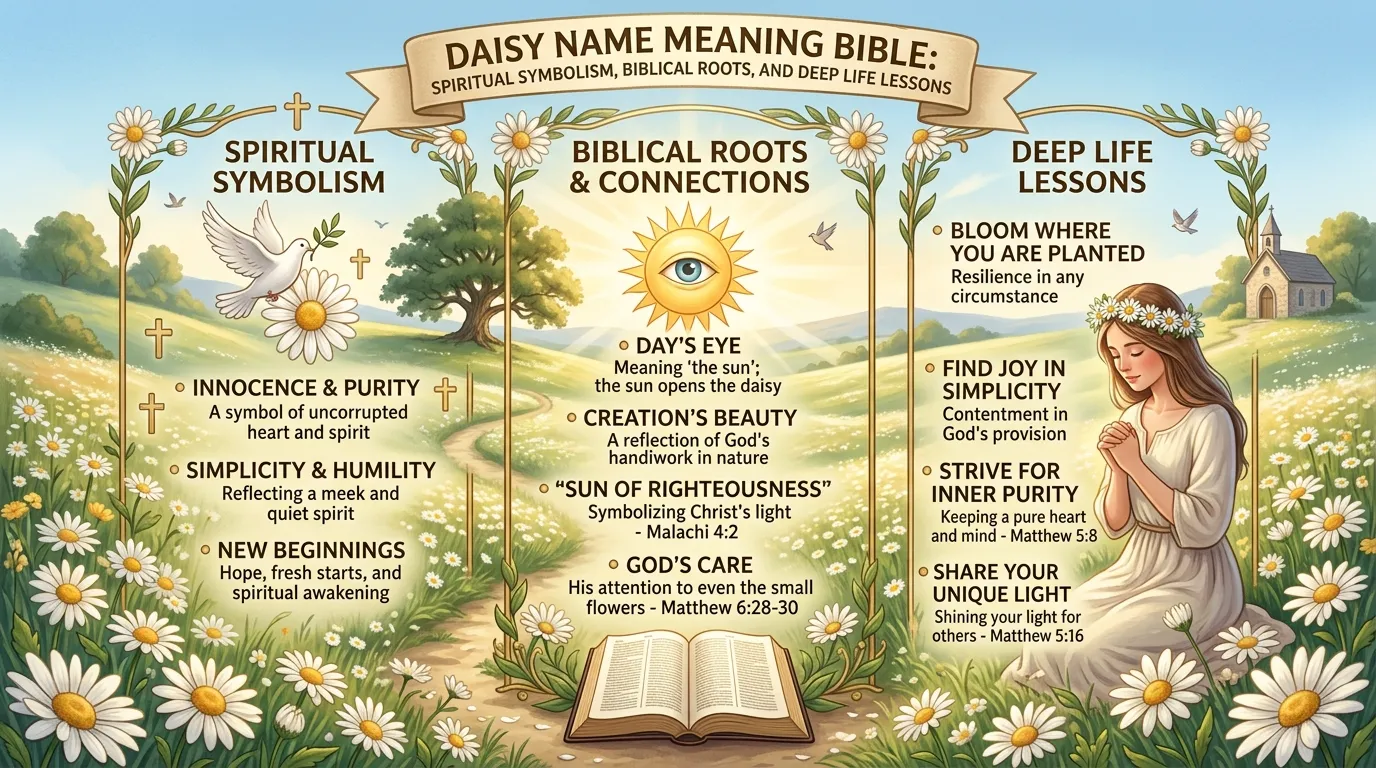
Have you ever wondered why certain names feel deeply peaceful, comforting, or spiritually meaningful? The Daisy name meaning Bible has captured attention because it symbolizes purity, renewal, innocence, joy, and emotional healing.
Although Daisy does not directly appear in Scripture, its floral symbolism strongly connects with biblical themes of beauty, hope, growth, and God’s creation.
In many spiritual interpretations, Daisy represents fresh beginnings after difficult seasons, reminding people that light and peace can still bloom during emotional struggles.
The simple beauty of the daisy flower reflects humility, kindness, and quiet strength qualities often praised throughout the Bible. Many people searching for the biblical meaning of Daisy are also searching for deeper answers about identity, purpose, relationships, and inner peace.
Spiritually, the name Daisy encourages emotional growth, gratitude, faith, and personal transformation while reminding us that even small moments of hope can carry powerful meaning in life’s journey.
What Does the Name Daisy Mean in the Bible?
Featured Snippet Answer
The name Daisy comes from the Old English word dægeseage, meaning “day’s eye” — a poetic description of the flower that opens its petals at sunrise and closes them at dusk. Daisy does not appear by name in the Bible, but the daisy flower belongs to the same family of wildflowers Jesus referenced in Matthew 6:28–29, where He used flowers of the field to teach about trusting God’s provision. Spiritually, the name Daisy symbolizes purity of heart, divine light, trust in God’s care, renewal after hardship, and faithful devotion.
Is Daisy in the Bible?
Daisy does not appear by name in the Bible.
The name is of Old English origin and was not present in ancient Hebrew or Greek scriptures. However, this does not diminish its spiritual significance — because the symbolism of the daisy flows powerfully through biblical themes.
The closest and most meaningful biblical connection comes from the words of Jesus Himself:
“Consider how the wildflowers grow. They do not labor or spin. Yet I tell you, not even Solomon in all his splendor was dressed like one of these. If that is how God clothes the grass of the field… will He not much more clothe you?” — Luke 12:27–28
The daisy, as a wildflower of the field, falls directly under this teaching. And interestingly, Bible scholars at BiblePlaces.com note that members of the daisy family — including crown daisy and dog chamomile — were actually abundant in the fields of ancient Israel and Galilee, the very region where Jesus walked and taught.
This means when Jesus said “consider the wildflowers,” He may have been pointing at flowers in the same family as the daisy.
What this reveals:
- Daisy is connected to one of Jesus’ most beloved teachings
- The flower represents God’s intimate care for ordinary, overlooked things
- Its spiritual message is about trust, not striving
Old English, Greek, and Hebrew Origin of Daisy
The Old English Root: “Day’s Eye”
The name Daisy comes from the Old English word dægeseage, which translates literally to “day’s eye.” This beautiful phrase describes the flower’s daily habit of opening at sunrise and closing at sunset — as if greeting God’s light each morning with quiet faithfulness.
Spiritually, this is extraordinary. In Scripture, light is one of the most powerful symbols of God’s presence, truth, and salvation.
“The Lord is my light and my salvation — whom shall I fear?” — Psalm 27:1
A name meaning “eye of the day” is essentially a name that speaks of turning toward God’s light — every single morning, without fail.
The Greek Connection
Daisy is historically linked to the name Margaret, which comes from the Greek margarita, meaning “pearl.” Jesus used the pearl as one of His most powerful kingdom metaphors:
“The kingdom of heaven is like a merchant seeking beautiful pearls, who, when he had found one pearl of great price, went and sold all that he had and bought it.” — Matthew 13:45–46
A name connected to the pearl symbolism speaks of hidden value, spiritual treasure, and extraordinary worth — even when unrecognized by the world.
The Hebrew Connection
In Hebrew symbolic tradition, the name Daisy is connected to the meaning of “gentle.” This is not a weak quality in Scripture — it is a holy one.
“Blessed are the meek, for they shall inherit the earth.” — Matthew 5:5
So while Daisy is not a Hebrew biblical name, its meaning flows directly into the river of biblical wisdom — purity, gentleness, light, and hidden spiritual treasure.
Spiritual Meaning of the Name Daisy
1. Daisy Represents Purity of Heart Before God
The daisy’s white petals have long symbolized innocence and purity — qualities that God consistently calls His people toward throughout Scripture.
In Matthew 18:3, Jesus makes a stunning statement about the posture God desires from us:
“Unless you change and become like little children, you will never enter the kingdom of heaven.”
The childlike innocence associated with daisies — genuine, unguarded, simple — is exactly the heart posture God invites us into. This is not naivety. It is holy simplicity. It is the courage to be real in a world that rewards performance and image management.
Related Bible Verse:
“Blessed are the pure in heart, for they shall see God.” — Matthew 5:8
Simple Meaning:
This verse teaches that purity of heart is not about being perfect — it is about being sincere before God. The name Daisy spiritually calls people toward authenticity, transparency, and an undivided heart.
Modern Example:
In a world driven by social media comparison and carefully curated identities, the symbolism of Daisy offers a liberating truth: you do not need to perform for love. Simply being genuine before God and others is enough.
2. Daisy Symbolizes Trust in God’s Daily Provision
The most powerful biblical connection to the Daisy name is found in the teaching of Jesus about wildflowers and worry.
“Consider the lilies of the field, how they grow; they neither toil nor spin. Yet I tell you, even Solomon in all his glory was not arrayed like one of these. But if God so clothes the grass of the field… will He not much more clothe you?” — Matthew 6:28–30
A flower that opens every morning with the rising sun — a day’s eye — is a living sermon on effortless trust. It does not worry about tomorrow. It does not strive or compete. It simply opens — fully present to today, fully dependent on the God who makes the morning.
Spiritual Insight:
If you carry the name Daisy, you may be spiritually called to model this kind of trust — to be a person whose faith is steady, daily, and unafraid. Not passive, but peacefully anchored in the knowledge that God provides.
For Those Struggling with Anxiety:
Jesus used wildflowers specifically to address worry (Matthew 6:25–34). If anxiety is a battle you face, your name holds a biblical antidote — a daily reminder that the same God who clothes the wildflower in breathtaking beauty holds your future in His hands.
3. Daisy Reflects Renewal and Hope After Hard Seasons
Daisies are perennial flowers. They return season after season — even after harsh winters, even after frost, even after everything seems dead. In biblical symbolism, this is a vivid picture of resurrection hope and spiritual renewal.
“I will be like the dew to Israel; he shall blossom like the lily.” — Hosea 14:5
The return of flowers after winter is one of nature’s most consistent symbols of God’s promise: death and darkness do not have the final word. New seasons come. New life emerges. What felt buried can bloom again.
Related Bible Verse:
“See, I am making all things new.” — Revelation 21:5
Spiritual Insight:
For anyone named Daisy who has walked through grief, loss, depression, relationship breakdown, or spiritual emptiness — this is personal. Your name whispers the promise that renewal is not just possible. It is coming.
Modern Example:
Many people feel drawn to the name Daisy during seasons of emotional recovery. The symbolism of the flower — surviving winter and blooming again — speaks directly to the human experience of healing after pain.
4. Daisy Represents Humble Beauty and Quiet Purpose
The daisy is not a rose or an orchid. It is small, common, and grows wild in open fields with no special care or attention. And yet it is beautiful. And yet Jesus pointed to it. And yet God clothes it in glory.
“Do nothing from selfish ambition or conceit, but in humility count others more significant than yourselves.” — Philippians 2:3
Spiritual Meaning:
The Daisy name spiritually echoes the posture of humble, quiet greatness. True impact in God’s Kingdom does not always announce itself with noise and spectacle. It often blooms quietly — in ordinary places, through faithful small acts, through genuine presence in the lives of others.
Personality Traits Often Associated with Daisy:
- Warmth and approachability
- Genuine kindness
- Emotional sensitivity
- Creative expression
- Quiet resilience
- Nurturing energy
Of course, no name guarantees personality. But symbolic meanings can inspire powerful self-reflection and intentional growth.
5. Daisy Symbolizes Spiritual Awakening and Turning Toward Light
Because the daisy opens at dawn — literally following the light of the sun — it carries the deep spiritual meaning of awakening, seeking God’s presence, and orienting the heart toward divine truth.
“In the morning, Lord, you hear my voice; in the morning I lay my requests before you and wait expectantly.” — Psalm 5:3
In Christian tradition, the daisy has also been connected to the Virgin Mary, symbolizing purity, devoted love, and chastity — a heart fully turned toward God.
Spiritual Insight:
The name Daisy is fundamentally a name about direction. Just as the flower turns toward the sun, the spiritual calling embedded in this name is to turn toward God — in the morning, in difficulty, in joy, in uncertainty. Consistently. Faithfully. Daily.
Daisy Name Meaning in Modern Life
Why the Name Daisy Feels So Relevant Today
Modern life creates enormous pressure around identity, achievement, and self-worth. Many people struggle with:
- Chronic anxiety and overthinking
- Social media comparison and identity confusion
- Fear of failure and imposter syndrome
- Emotional burnout and spiritual emptiness
- Relationship confusion and loneliness
The spiritual symbolism behind Daisy speaks directly into these struggles — because it centers around trust and simplicity, not striving and performance.
Daisy and Anxiety
Anxiety often makes people feel trapped inside worst-case scenarios. The mind races. The heart fears. The future feels threatening.
The symbolism of Daisy — a flower that opens every morning without worry — offers a profound counter-message:
- Rest is built into creation
- Trust is more powerful than control
- God’s care does not require your panic
- One day at a time is enough
Like a flower that simply opens to the light, emotional healing often begins not with more effort — but with releasing control and trusting the process.
Daisy and Identity Confusion
Many people ask:
- “Who am I really?”
- “What is my purpose?”
- “Why do I feel disconnected from myself?”
The biblical symbolism behind Daisy encourages a grounding perspective: identity is not something you perform — it is something you grow into. Just as the daisy does not force itself to bloom, healthy identity unfolds through:
- Honest self-reflection
- Faith and prayer
- Life experience
- Authentic relationships
- Emotional awareness
Daisy and Relationships
The name Daisy connects symbolically to warmth, emotional generosity, and faithful presence in relationships. The qualities spiritually associated with Daisy — gentleness, purity, quiet strength — are the exact qualities that build lasting, meaningful relationships.
Healthy growth-oriented relationships include:
- Honest communication
- Emotional safety
- Patience with each other’s growth
- Accountability rooted in love
- Genuine compassion
Dreams and Signs: What Does It Mean When Daisies Keep Appearing?
Spiritual Interpretation of Seeing Daisies Repeatedly
Many people report noticing certain names, symbols, or images repeatedly in:
- Dreams
- Unexpected conversations
- Social media
- Books or songs
- Quiet moments of reflection
If daisies or the name Daisy keeps appearing in your life, it may carry a spiritual invitation to reflect on themes of:
- Purity and sincerity before God
- Trust during a season of anxiety or uncertainty
- Renewal after emotional pain
- Turning your attention back toward hope and light
However, balance is important here. Not every repeated sign is a supernatural message. Sometimes the meaning comes from what the symbol emotionally represents to you — and what your soul is quietly processing.
Psychological Explanation: The Reticular Activating System (RAS)
Psychology offers a fascinating and grounded perspective on repeated signs.
The brain has a filtering system called the Reticular Activating System (RAS). Once something captures your emotional attention — like the name Daisy or the daisy flower — your brain begins noticing it more frequently in your environment.
This does not mean magic or supernatural intervention in every case. It reflects:
- Emotional focus and subconscious processing
- Identity exploration and self-reflection
- Unresolved thoughts your mind is working through
- The brain naturally seeking patterns connected to what it finds meaningful
Scientific Insights Behind Name Symbolism
1. Identity Formation and Names
Psychologists believe names can meaningfully influence self-perception and social expectations — a phenomenon called Implicit Egotism. People feel naturally drawn toward symbols, sounds, and meanings connected to their identity. Understanding the spiritual meaning of your name can positively shape self-concept and emotional confidence.
2. Emotional Symbolism and the Brain
The human brain responds strongly to symbolic nature imagery. Words associated with:
- Blooming
- Light
- Purity
- Renewal
- Morning
trigger positive emotional responses because they are connected to survival, hope, and emotional safety at a neurological level. This helps explain why the name Daisy — and its symbolism — feels emotionally uplifting to so many people.
3. Dreams and the Subconscious Mind
Dreams frequently communicate through symbols rather than direct language. If daisies appear in your dreams, they may represent:
- A growing part of yourself emerging
- Emotional healing that is underway
- A desire for peace, simplicity, or authenticity
- New creative or spiritual beginnings
- The subconscious processing of hope after pain
The meaning is often deeply personal rather than universal — and worth reflecting on with honesty.
Life Lessons Inspired by the Daisy Name Meaning in Bible
1. Begin Each Morning Turning Toward Light
The daisy opens at sunrise — every single day, without fail. This is a simple but powerful spiritual habit.
Helpful Habit: Spend 5–10 minutes each morning in quiet prayer, gratitude, or stillness before the noise of the day begins. Orient your heart toward God before the world pulls your attention elsewhere.
“In the morning, Lord, you hear my voice.” — Psalm 5:3
2. Practice Trusting God with What You Cannot Control
Anxiety grows when we try to control outcomes beyond our reach. The symbolism of Daisy calls people back to trust.
Practical Reminder: Write down one thing today that you are releasing to God. Not ignoring — but trusting. There is a difference between responsible action and exhausting control.
3. Embrace Simplicity Over Performance
The daisy does not compete. It does not apologize for not being a rose. It simply blooms — fully itself, fully enough.
Reflection Question: Where in your life are you performing instead of simply being? Where have you forgotten that your worth is not earned?
4. Build a Daily Gratitude Practice
Gratitude shifts the heart away from fear and scarcity toward abundance and trust.
Simple Habit: Each evening, write down:
- 3 things you were grateful for today
- 1 moment of unexpected beauty or kindness
- 1 area where you saw God’s provision — however small
5. Let Healing Be Gradual
Daisies return after winter — but not overnight. Healing, growth, and spiritual maturity all take time.
Practical Reminder:
- Progress matters more than speed
- Healing is not linear
- Small steps are still movement
- Rest is not failure — it is part of the process
6. Strengthen Prayer and Emotional Honesty
Like the flower that opens honestly to the light — without pretense — prayer works best when it is honest.
Example Prayer: “God, I don’t have everything figured out. But I’m turning toward You today — like the daisy turns toward the sun. Help me trust Your care, grow in Your grace, and bloom where You have planted me.”
Biblical Themes Connected to the Name Daisy
Although Daisy does not appear by name in Scripture, the name strongly aligns with several powerful biblical themes:
| Theme | Biblical Connection |
| Purity | Matthew 5:8 — Blessed are the pure in heart |
| Light | Psalm 27:1 — The Lord is my light |
| Trust | Matthew 6:28–30 — Consider the wildflowers |
| Renewal | Revelation 21:5 — I make all things new |
| Humility | Matthew 5:5 — Blessed are the meek |
| Gentleness | Philippians 4:5 — Let your gentleness be evident |
| New Life | Hosea 14:5 — He shall blossom like the lily |
| God’s Care | Luke 12:27–28 — God clothes the wildflowers |
Common Misunderstandings About Spiritual Name Meanings
It is important to stay balanced and honest.
A Healthy Perspective
A name is not automatically:
- A divine prophecy written over your life
- A supernatural guarantee of destiny
- A prediction of who you will become
However, names can carry:
- Deep emotional and symbolic significance
- Spiritual inspiration for reflection and growth
- Personal meaning that shapes identity over time
- A lens through which to approach life with more intention
The healthiest approach is thoughtful reflection — not fear, obsession, or superstition. Use the meaning as an invitation to grow, not a burden to carry.
FAQs:
Is Daisy a biblical name?
No. Daisy does not appear by name in the Old or New Testament. It is of Old English origin, meaning “day’s eye.” However, its spiritual symbolism — purity, light, trust, and renewal — aligns deeply with biblical themes, and the daisy flower is related to wildflowers mentioned in Jesus’ teachings in Matthew 6:28–30 and Luke 12:27–28.
What does the name Daisy mean spiritually?
Spiritually, Daisy symbolizes purity of heart, trust in God’s daily provision, renewal after hardship, humility, and turning toward divine light. It also carries connections to resurrection hope, gentle strength, and faithful devotion.
What Bible verse relates to the name Daisy?
The closest and most meaningful Bible verse is Matthew 6:28–30, where Jesus says: “Consider the lilies of the field, how they grow; they neither toil nor spin. Yet I tell you, even Solomon in all his glory was not arrayed like one of these.” The daisy, as a wildflower of the field, carries the full spiritual weight of this powerful teaching.
What does it mean spiritually to keep seeing daisies?
Repeatedly noticing daisies may be a spiritual invitation to reflect on purity, trust, and renewal — especially during seasons of anxiety, change, or emotional pain. Psychologically, it may reflect your subconscious processing themes of hope and new beginnings. From a spiritual perspective, it can be a gentle reminder to turn toward God and trust His care in your current season.
Is Daisy a good Christian name?
Absolutely. While Daisy is not a traditional Hebrew or Greek biblical name, it carries beautiful spiritual symbolism entirely consistent with Christian values — innocence, humility, joy, trust in God, and faithful daily devotion. Many Christian families choose names based on character and meaning, and Daisy carries a meaning worthy of that intention.
Final Thoughts :
The deeper beauty of the Daisy name meaning in the Bible is not found in fame, power, or complexity but in something far more enduring: faithful simplicity.
A small wildflower opening its petals at dawn may seem insignificant. It does not demand attention. It does not compete for admiration. It simply turns toward the light every single morning and trusts the God who made the sun rise again.
That is the spiritual heart of the name Daisy.
In a world that glorifies noise, striving, and constant self-promotion, the message carried by this name feels quietly revolutionary:
You do not need to earn your worth. You do not need to perform your purpose. You simply need to turn toward the Light and trust the One who holds every season.
Healing can begin gently. Purpose can unfold gradually. Renewal is real even after the longest winters. And the God who clothes the wildflowers in breathtaking glory sees you fully, completely, and with profound love.
Whether you carry the name Daisy, love someone who does, or simply feel drawn to its meaning the spiritual symbolism offers a timeless reminder:
You were created to bloom. And the God who made the morning is still making all things new.